
Insights
AMAZON PRIME DAY The Winning Formula for Media The Hidden Playbook Every Brand Should Know Before the Budgets Go Live

By Jackie Kalwani | Director - Media & Business Growth
Every year, brands pour millions into Amazon Prime Day media. Every year, a handful of them dramatically outperform the rest, often well-prepared.
After years of running media for brands across categories on Amazon, we have distilled what moves the needle. This is not a theoretical framework. It is the playbook we use, the consumer-obsessed, data-backed, full-funnel approach that drives not just short-term sales spike, but long-term sustainable brand growth.
Prime Day is not won during the event. It is won in the four weeks before it.
- Consumer-Centric Strategy: Know Who You Are Chasing Before You Spend a Dollar
Most brands begin their Prime Day planning by asking, ‘How much should we spend?’ The right question is, ‘Who are we trying to reach, and how are they behaving right now?’
Consumer behaviour in any category begins shifting four weeks before Prime Day. Shoppers enter a research mode and start building baskets, comparing options, bookmarking deals. Search trends evolve. New keywords gain traction. Complementary and parallel search terms start to spike as shoppers explore adjacent products.
Brands that track these behavioural signals early gain a decisive edge. Here is what we look for:
→ Trending search terms: What are shoppers in your category actively searching for? Not last month, right now & trend spotting patterns during historical behaviour during Prime Day
→ CTR-driving factors: Which headlines, claims, and product benefits are generating the highest click-through? This varies by category and changes ahead of events.
→ Conversion triggers: What are shoppers evaluating before they buy? Price, reviews, bundle value, Needs, Aspirations?
→ Impulse purchase signals: One of our most consistent Prime Day findings - a significant cohort of high-intent shoppers are not searching for your product. They are searching for ‘Best Prime Day Deals,’ ‘Top Offers Today,’ or ‘Best Deals of the Day.’ These are impulse buyers, and across multiple brand categories we manage, they have delivered outsized conversion rates.
Investing in deal-discovery and event-generic keywords is not a compromise. It is a deliberate tactic to capture consumers who arrive on platform with intent to buy something, they just have not decided what yet. Your job is to make sure it is your brand that makes through that cut.
- Investment Strategy: StartWiththe Business, Not the Budget
Before allocating a single pound or dollar, step back. Set a clear business target. What sales number does Prime Day need to deliver? What new-to-brand acquisition is expected? What market share movement is realistic?
From there, apply the E-commerce growth formula that underpins every investment decision we make at PiWheel:
Traffic × Conversion Rate = Sales
This equation gives every investment decision a commercial anchor. If you set your target sales, and you benchmark your current conversion rate versus category average, you can calculate exactly how much Traffic Share of Voice (SOV) you need to close the gap.
- 1. Setyour Sales Target - What does Prime Day need to deliver? Define a number.
- 2. BenchmarkConversion Rate - How does your PDP performance compare to the category? Close the gap with content before spending on media.
- 3. CalculateTraffic SOV Required - Work backwards from target sales to determine the traffic volume you must capture.
- 4. Identifythe Investment Bridge - The gap between your current traffic SOV and required SOV is your media investment indicator.
This approach ensures investment is grounded in commercial outcome, not gut feel, historical spend, or competitor imitation.
- Full Funnel Media: Phase Your Strategy Effectively
Prime Day is not a single-day event for consumers. Baskets are built over weeks. Decisions are often made before the event begins. A flat, always-on approach to media misses this entirely.
The winning formula is a phased full-funnel strategy that mirrors how consumers behave from early awareness through to event-day conversion.
At PiWheel, we recommend a deliberate shift in the DSP-to-Sponsored Ads ratio across phases:
Phase
DSP
Sp. Ads
Strategic Objective
Lead-Up Phase
60%
40%
Maximize reach, brand recall & traffic growth. DSP drives upper-funnel awareness on & off Amazon.
Prime Day Event
20%
80%
Capture high-intent shoppers in-the-moment. Sponsored Ads dominate every keyword, every placement.
These ratios are a thumb rule, not a rigid prescription. High-involvement categories (tech, premium beauty) may warrant sustained DSP investment even during the event. Low-involvement impulse categories should lean heavily into Sponsored Ads from day one of the event.
Why does this matter? Because Amazon DSP gives you reach that Sponsored Ads cannot - shoppers browsing off-Amazon, audiences on streaming platforms, in-market consumers who have not yet arrived on the SERP. Building that pipeline during the lead-up period means your Sponsored Ads are converting a warmer, already-influenced audience on event day.
Brands that win Prime Day do not turn on the machine on the day. They have already warmed the engine for weeks.
- Advertised SKU Strategy: Pick Your Battles, Win the Right Ones
One of the most common and costly Prime Day mistakes is over-indexing across the entire catalogue. Spreading investment evenly feels safe. It is not. It dilutes impact and leaves your best opportunities under-resourced.
At PiWheel, we apply our Product Growth Framework: a two-axis benchmarking approach that plots every SKU against category averages on Traffic and Conversion Rate.
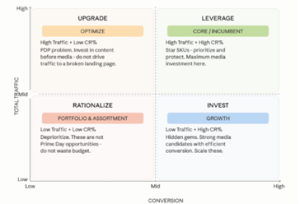
Overlay this with one final filter: SKUs that carry Prime Day Deal badges. Deal tags are attention-stealers. A product with a deal badge, strong content, and focused media spend is a Prime Day winner.
- LeveragingAMC: The Intelligence Layer That Most Brands Ignore
Amazon Marketing Cloud (AMC) is one of the most underutilised tools in the Amazon advertising ecosystem and one of the most powerful for Prime Day planning.
AMC allows brands to analyse the Path to Purchase across multiple touchpoints, understand which media formats are driving genuine incrementality, and build audience signals that inform both creative and targeting decisions.
Here is how we apply AMC intelligence ahead of Prime Day:
→ Multi-touch attribution: Understand which ad format between DSP display, Sponsored Brand Video, Sponsored Product is influencing conversion, not just getting last-click credit.
→ Audience overlap analysis: Which DSP audiences convert at the highest rate? Which Sponsored Ad placements drive the most new-to-brand customers?
→ Creative performance by format: Video versus static, Sponsored Brand versus Sponsored Product - AMC tells you where your creative investment is delivering effectively.
→ Custom segment activation: Build lookalike audiences based on last year’s Prime Day converters and re-engage them this year via DSP.
→ Frequency Analysis: Operate at effective and efficient frequency controls during lead up & event phases.
Brands that enter Prime Day with AMC-backed media mix decisions are not guessing at format allocation - they are scripting success at scale.
- Media Efficiency & Hygiene: The Unsexy Work That Compounds Results
Strategy gets the credit. Execution delivers the results. During Prime Day, with CPCs spiking and competition at its peak, media hygiene is what separates efficient spenders from wasteful ones.
Our pre-Prime Day efficiency checklist:
→ Bidding strategy review: Are your bids calibrated for a high-competition event environment? Manual bids need reviewing; dynamic bidding rules need stress-testing.
→ CPC caps by placement: Set CPC caps by placement type to avoid auction inflation eroding your returns during peak periods.
→ Day-parting configuration: Analyse historical hour-by-hour conversion data. Concentrate spends in high-conversion windows and pull back during low-performing hours.
→ Daily spend pacing: Avoid front-loading your budget in the first hours of the event. Pace spend to ensure you are active and competitive throughout both Prime Day events.
→ AI and automation: Smart bidding and rule-based automation to react in real time to competitive shifts.
→ Placement bid adjustments: Top-of-search placement premiums often deliver the highest return during Prime Day. Test and calibrate these in the lead-up period.
None of this is glamorous. All of it is essential.
The brands that compound every percentage point of efficiency are the ones who look back at Prime Day and set records.
The Hidden Playbook: What Separates Winners from Participants
Most brands will show up to Prime Day. Very few will be ready for it.
Participants
The Winners
Increase budgets and hope
Set commercial targets, then build backwards
Copy last year campaign tactics
Start with today’s consumer behaviour signals
Aggressive spend on Day 1
Phase the funnel - warm it up, conversions will follow
Spread budget across all SKUs
Concentrate on products built to win
Guess at format mix
Use AMC data to replicate what already works
React to problems during event
Prepare backup creatives and pacing rules in advance
The brands that win Prime Day follow the same six moves, executed before the event begins:
→ Read the consumer before you brief the campaign: Trend spotting and behavioural signals are your first media input.
→ Set a sales target. Work backwards to investment: Traffic SOV gap is your investment brief
→ Warm the funnel with DSP. Convert with Sponsored Ads: 60:40 lead-up. 20:80 on event day
→ Pick your hero SKUs. High Traffic + High CR% wins. Everything else is a distraction
→ Let AMC choose your media mix, not instinct: Multi-touch path data removes the guesswork from format allocation
→ Obsess over efficiency: Bid caps. Dayparting. Pacing The compounding effect of 1% gains across every lever adds up to wins
Prime Day does not reward the loudest brand. It rewards the most prepared one.
“This is the PiWheel formula. But it takes rigour, time and expertise to execute with precision.”
If you want to run this playbook, or want us to run it for you -
let’s talk before Prime Day does.
PiWheel | Let’s Connect
Strategy · Content · Media


